Choosing the best leg brace supplier in China requires more than comparing prices. A reliable partner should understand anatomy, material performance, production control, and the needs of different users. Look for suppliers with documented experience in orthopedic support products, clear quality procedures, and trained technical teams. Their product information should explain sizing, intended use, materials, adjustment methods, and care instructions. Vague answers are warning signs.
Request samples before discussing large orders. Examine the stitching around the straps, the smoothness of the hinges, and the firmness of the foam padding. Ask how the supplier checks measurements, compression, labeling, and packaging during production. A professional factory should share inspection records, product specifications, and relevant certifications when applicable to your target market. It should also support reasonable customization without hiding limitations. Communication matters.
Not every attractive catalog reflects consistent manufacturing quality. Some suppliers may deliver an excellent sample but struggle with repeated production. This is where careful verification becomes essential. Discuss lead times, minimum order quantities, replacement handling, and communication during delays. Ask for a factory video call or an independent inspection when practical. Small details can reveal a lot. Still, no supplier is perfect. Even experienced factories may need clearer drawings, revised samples, or extra testing. A dependable partner admits problems and corrects them transparently. This guide explains how to compare Chinese suppliers with practical evidence, professional judgment, and attention to user safety. The goal is not simply to find the cheapest leg brace. It is to build a stable supply relationship that protects product quality, customer trust, and long-term business value.
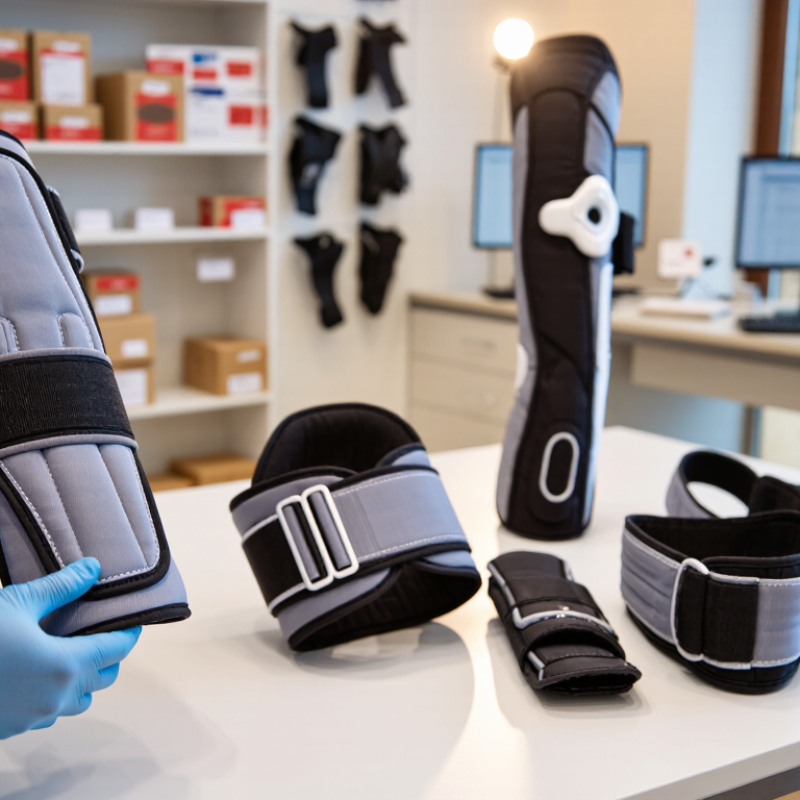
China’s leg brace supplier market is expanding with broader rehabilitation demand. Grand View Research estimates the global orthopedic braces and supports market reached about USD 4.6 billion in 2023. It also forecasts steady growth through 2030. China’s aging population adds practical pressure. The National Bureau of Statistics reported 296.97 million residents aged 60 or above in 2023, representing 21.1% of the population.
The supplier landscape includes medical-device factories, rehabilitation manufacturers, and specialized orthopedic workshops. Their capabilities differ sharply. A reliable supplier should provide ISO 13485 quality-system evidence and clear product documentation. Buyers should also verify applicable NMPA registration or filing information before discussing distribution. Ask for material specifications, hinge-cycle tests, size tolerances, and skin-contact safety records. Request samples from different production batches. One sample proves very little.
Factory visits can reveal useful details. Observe cutting accuracy, stitching tension, foam bonding, and final inspection records. Interact with the quality manager, not only the sales representative. TÜV SÜD’s medical-device industry guidance emphasizes traceability, risk management, and controlled production processes. These controls matter when a brace must support a knee during daily walking. I would not judge a supplier by a polished showroom alone. Some factories still rely on manual checks, and that weakness may appear only after repeated use. Ask how complaints are logged and how corrective actions are verified.
How to Choose the Best Leg Brace Supplier in China?
Defining Your Product, Quality, and Compliance Requirements
A reliable supplier search starts with a precise product definition. Describe the brace’s intended use, support level, body location, materials, and expected service life. Include measurements, adjustment ranges, closure types, and packaging details. A vague request often produces attractive samples that fail during daily movement.
Consider the user’s real environment. Will the brace face sweat, repeated bending, outdoor dust, or long wearing periods? Ask for material specifications, seam strength data, corrosion resistance, and cleaning instructions. Request samples in several sizes. Check pressure points, edge finishing, hinge movement, and comfort after several hours. Small details matter.
Quality claims need evidence. Review the supplier’s quality management certification, inspection procedures, batch records, and traceability system. For applicable products, request test reports covering materials, mechanical performance, skin contact, and labeling accuracy. Confirm that documents match the exact model, not a similar item. Compliance duties may vary by destination, product classification, and intended claims, so verify requirements with a qualified regulatory professional.
Do not rely on a polished factory tour alone. Ask how defects are handled, who approves production changes, and how complaints are investigated. A supplier may pass one inspection and still miss a recurring sizing problem. That risk deserves attention. Your specification may also contain assumptions. Recheck them after sample testing, especially when comfort and fit depend on different body shapes.
How to Choose the Best Leg Brace Supplier in China?
A capable leg brace supplier should understand anatomy, gait, pressure distribution, and daily user needs. Ask whether the technical team includes orthotic engineers or experienced product designers. Their answers should explain knee alignment, hinge movement, strap placement, and skin comfort clearly. Vague replies often indicate limited development experience.
Manufacturing quality deserves close inspection. Request photos or videos of cutting, stitching, molding, assembly, and final inspection. Check whether workers record material batches, dimensions, torque settings, and defect rates. Durable braces usually depend on small details, such as smooth edges, reinforced seams, and consistent hinge resistance. Ask for relevant test reports and quality procedures. A clean factory tour is useful, but it does not prove every batch is consistent.
Customization should go beyond printing a logo. A professional supplier can adjust brace length, circumference, padding thickness, hinge settings, colors, packaging, and user instructions. Share measurement charts and real fitting problems before requesting samples. Test the sample during walking, sitting, and stair movement. One sample may look perfect. It may still create pressure after two hours. This is easy to miss. Suppliers should record revisions and explain why each change was made. However, customization can increase cost, lead time, and inspection work. A supplier that promises everything immediately may be overlooking practical limits. Clear communication, traceable records, and honest technical feedback are stronger signs of reliability than a polished catalog.
Choosing a leg brace supplier in China requires more than comparing the lowest price. Request an itemized quote for the brace, packaging, tooling, sample fees, and shipping. Ask whether the price changes at 100, 500, or 1,000 units. A cheap unit price may hide expensive molds or unclear freight charges.
Minimum order quantities should match your sales forecast. A supplier requesting 5,000 units may create unnecessary inventory pressure. Smaller trial orders can reveal sizing problems, stitching weaknesses, or uncomfortable straps. Request a pre-production sample and compare it with the approved specification. Measure the hinge movement, fabric thickness, and carton dimensions. Small details matter.
Lead time must include material purchasing, sample approval, production, inspection, and shipment. Ask for dates in writing, not only “about three weeks.” Also check how the supplier handles delayed materials or rejected units. Reliable service includes clear drawings, quick technical replies, replacement procedures, and quality inspection records. Video calls can help confirm equipment and production capacity, but they are not a complete audit. I have seen buyers trust polished photos too quickly. That approach can fail. Ask for recent inspection evidence and a realistic production schedule before paying a deposit.
| Supplier Profile | Typical Product Scope | Indicative Quote (USD / Unit) |
MOQ | Sample Lead Time | Bulk Production Lead Time | Tooling / Setup Cost | Customization Capability | Quality & Compliance Support | Additional Services | Best Fit |
|---|---|---|---|---|---|---|---|---|---|---|
| A | Neoprene knee sleeves, elastic supports, basic compression braces | US$2.20–4.80 | 500 units per color or design | 7–10 days | 25–35 days | Usually none for standard designs; US$80–250 for logo or packaging setup | Logo printing, color changes, woven labels, private packaging | Material composition records, pre-shipment inspection, basic testing reports on request | Barcode labels, folding, polybagging, carton marking, export documentation | Entry-level products and online retail testing |
| B | Hinged knee braces, patella stabilizers, adjustable athletic supports | US$6.50–13.80 | 300 units per model | 10–14 days | 30–45 days | US$150–600 for customized components or packaging | Adjustable straps, fabric selection, hook-and-loop layout, color and logo customization | Dimensional inspection, stitching inspection, load or function checks, batch records | Size-set development, pre-production samples, inspection coordination, retail packaging | Sports, fitness, and general support applications |
| C | Post-operative knee braces, ROM braces, orthopedic immobilizers | US$14.00–32.00 | 200 units per model | 14–21 days | 35–55 days | US$500–2,000 when new plastic parts or metal components are required | Brace dimensions, hinge range, padding, straps, size grading, user instructions | Risk-management documentation support, material declarations, inspection records, traceability by batch | Engineering drawings, prototype revisions, assembly instructions, product manuals | Clinical-support distributors and specialized orthopedic channels |
| D | Compression knee supports, knitted braces, seamless sports supports | US$3.80–8.90 | 1,000 units per color and size range | 10–15 days | 30–40 days | US$100–400 for jacquard patterns, labels, or packaging artwork | Knitted patterns, compression zones, yarn composition, labels, color matching | Fabric composition testing, colorfastness checks, size measurement, elasticity checks | Size grading, hangtags, retail boxes, replenishment planning | High-volume private-label programs |
| E | Premium sports knee braces with silicone grips, aluminum stays, and advanced fabrics | US$10.50–24.00 | 500 units per model | 14–20 days | 40–60 days | US$800–3,500 for custom molds, hardware, or specialized components | Advanced material combinations, hardware selection, ergonomic adjustments, premium packaging | Functional testing, metal-component inspection, material declarations, production quality plans | Product development consultation, sample iterations, photo samples, drop-shipping preparation | Premium sports and rehabilitation product lines |
| F | General-purpose orthopedic supports, wrist and ankle supports, multi-product programs | US$4.50–16.00 | 300 units per SKU | 10–18 days | 35–50 days | US$200–1,500 depending on product complexity | Multiple product categories, coordinated branding, size and color development | Supplier quality agreement, incoming-material checks, final inspection, corrective-action support | Mixed-SKU consolidation, carton optimization, inventory planning, export support | Buyers seeking one supplier for a broader support-product range |
Comparison note: The prices shown are realistic China market-reference ranges for standard private-label orders and are not fixed quotations. Final pricing depends on materials, size assortment, packaging, testing requirements, order volume, shipping terms, and payment conditions. Confirm specifications, compliance documents, sample approval, and inspection standards before placing an order.
A reliable evaluation starts with physical samples, not attractive catalog photos. Request several sizes, materials, and adjustment systems. Test the brace on a real user or a fitting mannequin. Check edge softness, strap strength, hinge movement, and skin pressure after thirty minutes. Small defects matter. A loose stitch can become a serious complaint later. Ask whether samples match mass-production materials and construction. Some suppliers change components after approval, which is easy to miss.
Factory capability requires evidence, not confident promises. Review production lines, quality-control checkpoints, worker training, and packaging procedures. Request batch records, inspection reports, and traceable material details. A professional factory should explain its tolerance limits and correction process clearly. It should also handle design changes without confusion. During one evaluation, the sample was excellent, but production capacity was overstated. That mistake taught me to compare output records with actual equipment and staffing. Factory visits help, though photographs and video calls cannot replace independent verification.
Tips: Ask for a pre-production sample, a written inspection standard, and a realistic lead-time plan. Check how complaints are recorded and resolved. Request references from comparable buyers when possible. Do not judge reliability from one successful shipment. Review communication speed, document accuracy, and consistency across three orders. Leave room for uncertainty; even careful assessments can miss hidden problems.
2382 Faraday Avenue, Ste 300
Carlsbad, CA 92008
The materials on this website are for your general educational information only. Information you read on this website cannot replace the relationship that you have with your healthcare professional. We do not practice medicine or provide medical services or advice as a part of this website. You should always talk to your healthcare professional for diagnosis and treatment.
©2025 Breg, Inc. All rights reserved. All trademarks and registered trademarks are owned by the copyright holder.